T-money vs Climate Card: Transit Guide
Understand Korea transit payment as a compatibility problem: physical T-money, Climate Card, foreign credit cards, MobileTmoney, Apple Pay, contactless tap-to-ride and where each method really works in 2026.
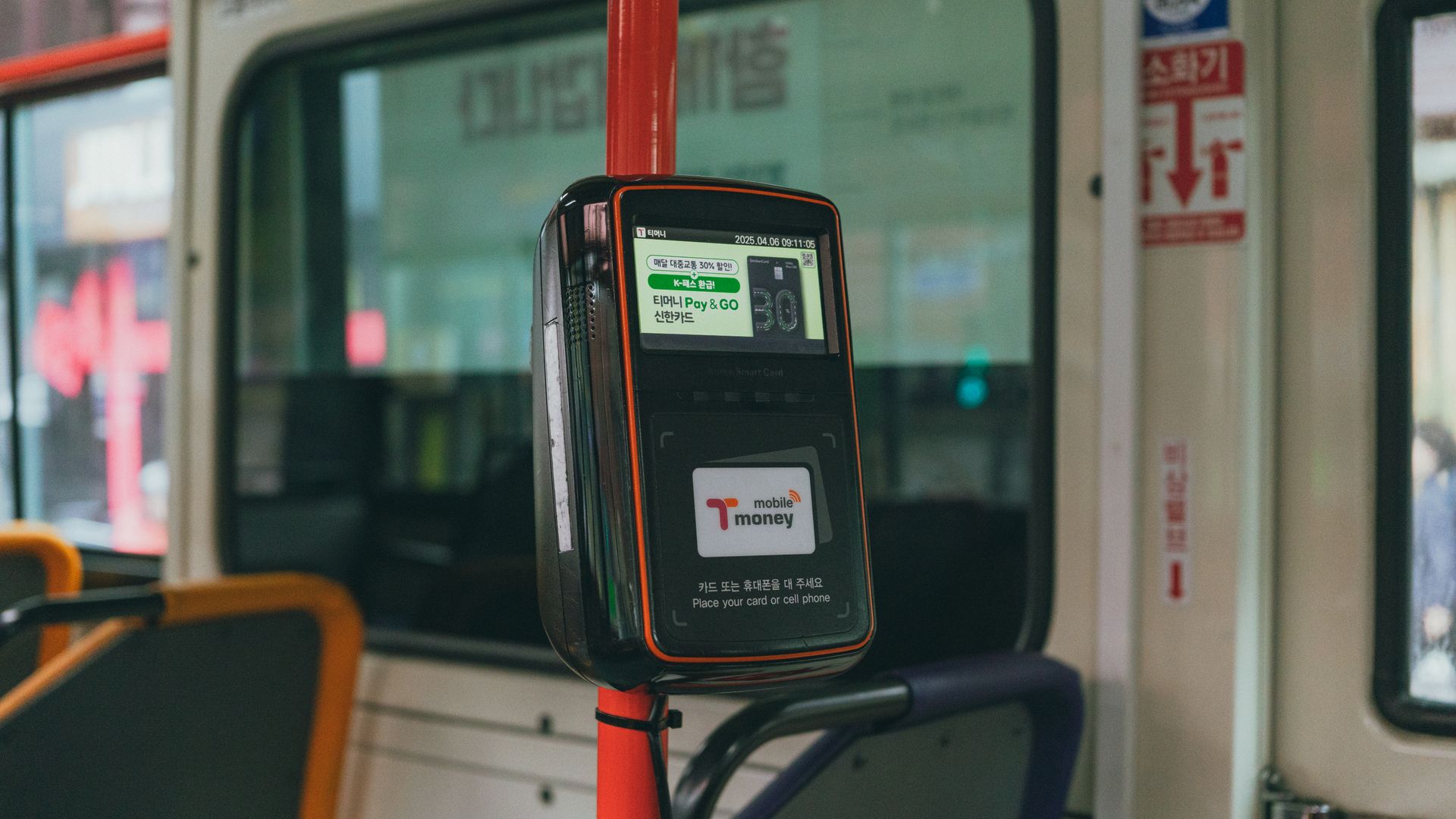
Shop card, transit card, reload card and gate tap are four different questions
T-money remains the robust visitor default, while Climate Card and MobileTmoney gained major foreign-card improvements in 2026. Do not assume an overseas bank card can yet be tapped directly at every Seoul gate.
Korea's payment system can be confusing for visitors because four different questions are often collapsed into one: Can my foreign card pay at a shop? Can it buy or recharge a transport card? Can I tap the same bank card directly at a subway gate? Can my phone act as the transport card? The answers are not identical.
The safest way to understand 2026 Korea transit is to separate closed-loop transport cards such as T-money from ordinary international bank cards. Seoul is moving toward EMV open-loop transit, but the city has described that as a staged programme running through 2030. As of September 2026, a visitor should not assume that an overseas Visa or Mastercard can simply be tapped at every Seoul subway gate or bus reader.
The 2026 visitor compatibility table
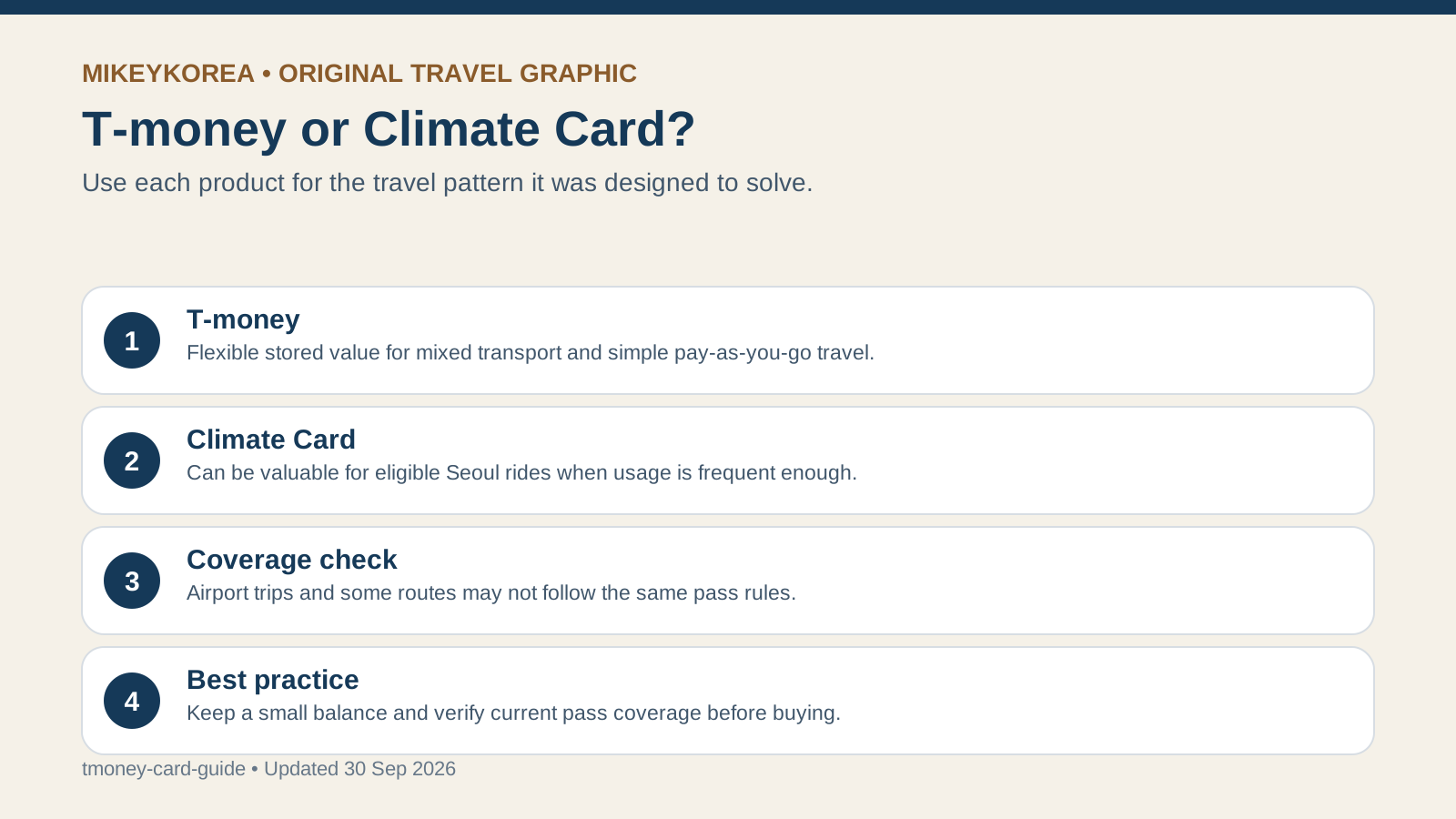
| Method | Ride subway/bus directly? | Can an overseas card help fund it? | Best use |
|---|---|---|---|
| Physical T-money | Yes, wherever T-money is accepted | Do not assume every ordinary T-money reload point accepts an overseas card; keep cash as a fallback | Flexible pay-as-you-go travel and broad visitor compatibility |
| Short-term Climate Card | Unlimited within its current coverage during validity | Yes at the new supported Seoul vending machines for short-term passes using internationally issued credit/debit cards | Intensive Seoul-only travel when the pass beats pay-as-you-go |
| Single-journey subway ticket | Subway only | Since 17 Mar 2026, international cards such as Visa/Mastercard are accepted at 440 new machines at 273 Lines 1–8 stations | Occasional ride without a transport card |
| MobileTmoney on iPhone / Apple Watch | Yes, as a T-money transport card | Current international-user app release notes list Mastercard, American Express, UnionPay and JCB for Apple Pay top-up | Visitors with a compatible iPhone/Watch and a supported card network |
| Foreign bank card tapped directly at gate | Not the universal Seoul default yet | Open-loop rollout is still staged | Do not rely on this unless the specific operator/terminal explicitly supports it |
1. Physical T-money: still the simplest universal fallback
T-money is a rechargeable transport card. Seoul's 2026 tourist guide describes it for airport shuttles, metropolitan buses, subway, taxis and also some retail uses such as convenience stores. You tap when entering and, where required, when exiting so that transfer discounts can be calculated correctly.
The important distinction is purchase/reload versus card usage. An overseas Visa may work perfectly at a department store but that does not guarantee the same card can reload a physical T-money at every machine or convenience store. Seoul has been upgrading vending machines, but the city's clearest 2026 international-card announcement specifically covers Climate Cards and single-journey tickets. For ordinary T-money, carrying a small cash reserve remains the least fragile visitor strategy.
2. Climate Card: international cards got easier in 2026
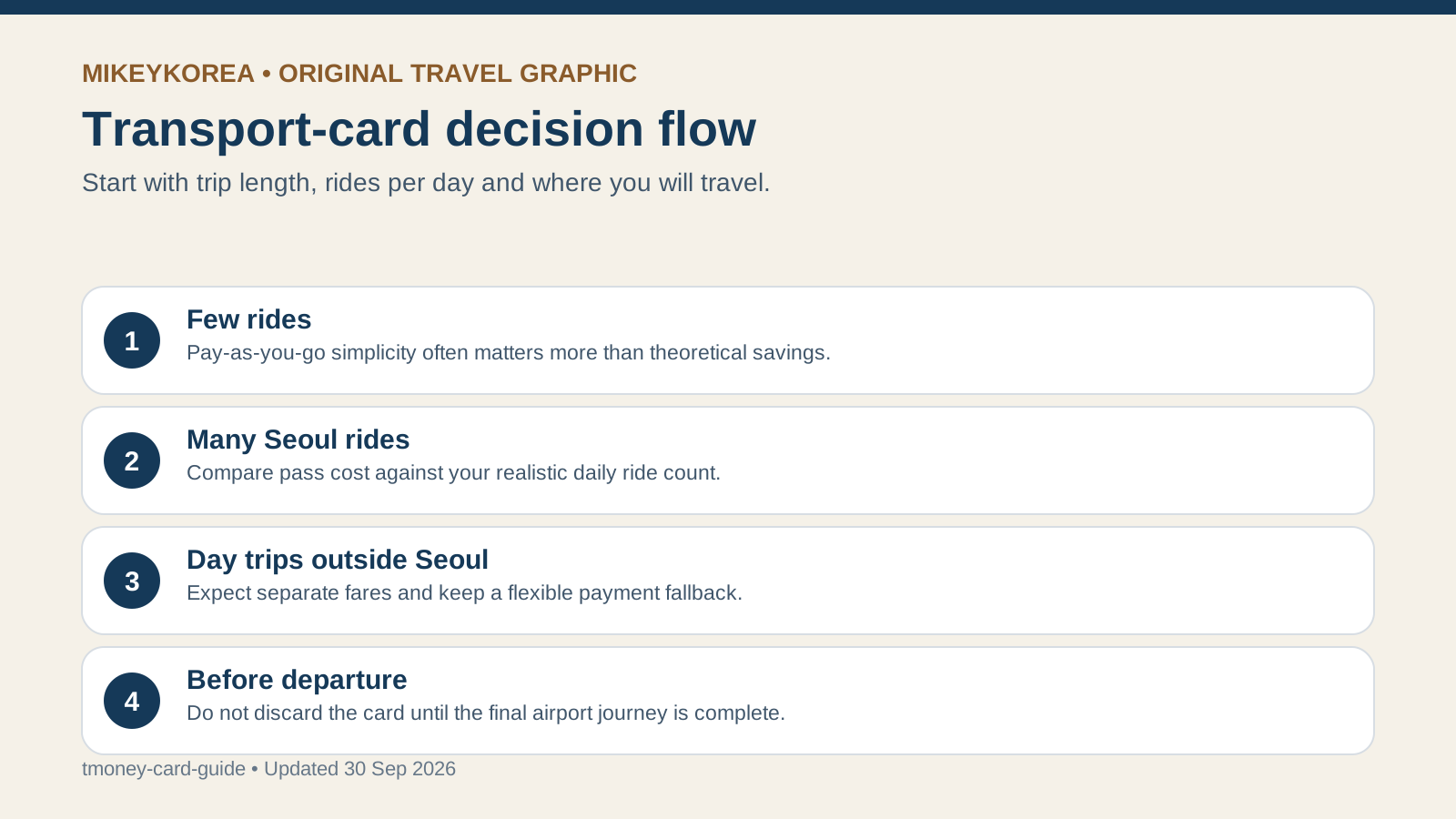
Starting 17 March 2026, Seoul enabled internationally issued credit and debit cards, including Visa and Mastercard, at 440 new transport-card vending machines across 273 stations on Lines 1–8 for purchasing/recharging short-term Climate Cards and for buying single-journey tickets. Seoul says an average service fee of about 3.7% applies to international-card payments.
Short-term tourist Climate Card prices remain 1 day ₩5,000, 2 days ₩8,000, 3 days ₩10,000, 5 days ₩15,000 and 7 days ₩20,000, plus the physical card where required. Do not confuse these tourist passes with Seoul's resident-focused monthly Climate Pass/Everyone's Card changes.
3. Can you tap a foreign Visa or Mastercard directly at the subway gate?
Not as a universal rule yet. Seoul announced an EMV open-loop transition plan in October 2025. The plan calls for EMV-certified modules and backend preparation in 2025–2026, replacement on Lines 1–8 in 2027, and wider expansion later. That means foreign-card support at a ticket machine is not the same thing as open-loop tap-to-ride at the gate.
If a particular operator later displays direct Visa/Mastercard contactless acceptance, use that specific current information. Until then, visitors should plan around T-money, Climate Card, MobileTmoney or a single-journey ticket rather than assuming London-style bank-card tapping everywhere.
4. iPhone and Apple Watch: MobileTmoney is now much more useful to visitors
Apple introduced T-money in Apple Wallet in 2025. In 2026, the MobileTmoney app expanded international-user support. Mastercard announced that international visitors can top up MobileTmoney with a Mastercard and then tap iPhone or Apple Watch on public transport. The current App Store version history (2.4.7, September 2026) lists Apple Pay top-up for Mastercard, American Express, UnionPay and JCB. Visa is not listed in that current release note, so a visitor carrying only Visa should not assume the same in-app top-up path will work.
This is different from simply adding any bank card to Apple Wallet and tapping the gate. The phone is acting as a T-money transport card.
5. Android: check the exact app and card network
Seoul has also promoted tourist mobile-payment improvements for Android. Mastercard states that international Android visitors can use the KOREA TOUR CARD app with Mastercard top-up. Because device model, NFC setting, app availability and card-network support can change, confirm the exact app before you travel instead of assuming every Android wallet behaves like Samsung Wallet in Korea.
Where T-money works—and where it is not a substitute
- Strong use cases: subway, city buses, many taxis and other T-money-enabled transport; selected retail purchases.
- Not a replacement for every rail ticket: KTX/SRT and reserved intercity services have their own ticketing.
- Airport transport varies: some airport buses/rail segments accept T-money or have their own ticket system; check the actual route.
- Climate Card is not the same as T-money: it is a time-limited pass with a defined service area.
What should visitors from different card markets do?
| What you carry | Practical setup |
|---|---|
| Mastercard + compatible iPhone | MobileTmoney is now a strong cashless option; keep a backup payment card. |
| AmEx / UnionPay / JCB + compatible iPhone | Current MobileTmoney release notes list these networks for Apple Pay top-up; still carry a backup. |
| Visa only | Do not assume MobileTmoney foreign-card top-up; physical T-money or a Climate Card with supported station purchase/reload may be easier. |
| Android + Mastercard | Check current KOREA TOUR CARD compatibility and NFC setup. |
| Any visitor who dislikes app dependency | Physical T-money plus a small cash reserve remains robust. |
| Heavy Seoul-only rider | Compare short-term Climate Card cost against your expected rides; use T-money for travel outside the pass coverage. |
The MikeyKorea transport-payment rule
Carry one primary bank card, one backup bank card or small cash reserve, and one deliberate transport solution. Do not expect one card to solve retail payment, transit-card reload and direct gate entry in exactly the same way.
Use the T-money vs Climate Card Calculator for the pass decision, then use this guide to check compatibility.
Sources and update date
- Seoul — Open-loop transit rollout plan
- Seoul — International cards for Climate Card and single-journey tickets, 17 Mar 2026
- Seoul — Climate Card rules
- Mastercard — MobileTmoney for international travellers
- MobileTmoney App Store listing / current release notes
Checked 27 September 2026. Payment acceptance changes quickly. This article intentionally distinguishes direct gate acceptance from purchasing or reloading a transport product.
Continue planning from here
Use the next step that matches the decision you are making now: T-money vs Climate Card calculator, Seoul subway guide, payment backup guide. These links are selected to continue the same travel task rather than send you back to a generic category page.
Use the guide, then test your own situation
Use your stay length and expected rides to calculate the break-even point rather than buying a transit product by habit.
Related Guides
Seoul Subway Guide: Exits & Transfers
The hard part of Seoul's subway is not buying a ticket—it is choosing the right exit, avoiding unnecessary transfers, handling luggage and matching the route to your walking tolerance.
Naver Map vs Google Maps in Korea in 2026: Which App for Walking, Transit, Driving & Places?
Use the right map app for the task. Naver Map is still the strongest visitor default for Korean routing and local place data in September 2026, while Google Maps remains useful for familiar global place discovery and saved lists.
Airport Rail vs Airport Bus to Seoul: Which Is Better for Your Hotel?
Compare AREX all-stop, AREX Express and airport limousine buses by the whole door-to-door trip: hotel district, luggage, group size, transfer effort, traffic risk and arrival time.