Tipping in Korea vs USA, UK & Japan: What Visitors Should Do
Compare tipping in Korea with the USA, UK and Japan, then use a simple situation-by-situation guide for restaurants, taxis, hotels and tours.
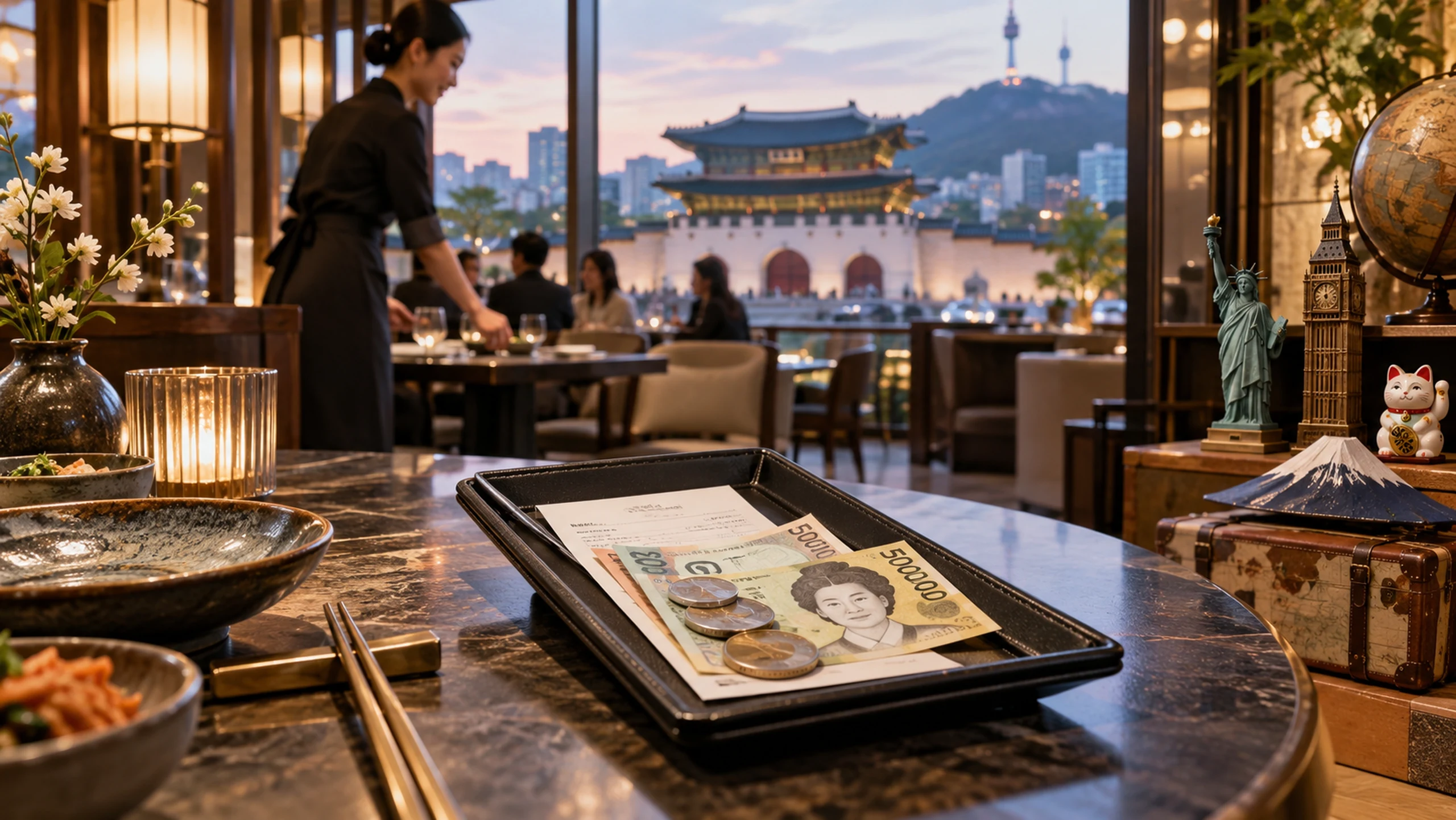
If you arrive in Seoul from the United States, the hardest thing about tipping can be doing nothing. If you arrive from Japan, Korea may feel far more familiar. If you arrive from Britain, the Korean rule is simpler than checking whether a restaurant has quietly added a service charge. The practical starting point is straightforward: routine tipping is not required or expected in ordinary Korean restaurants, and the listed or metered price is normally the price you pay.
The useful question is not “Does Korea tip?” but “Which habit from home should I leave at home?” This guide compares Korea with the United States, Britain and Japan so you can recognise when your instinct is coming from your own service culture rather than from the Korean transaction in front of you.
The four-country tipping snapshot
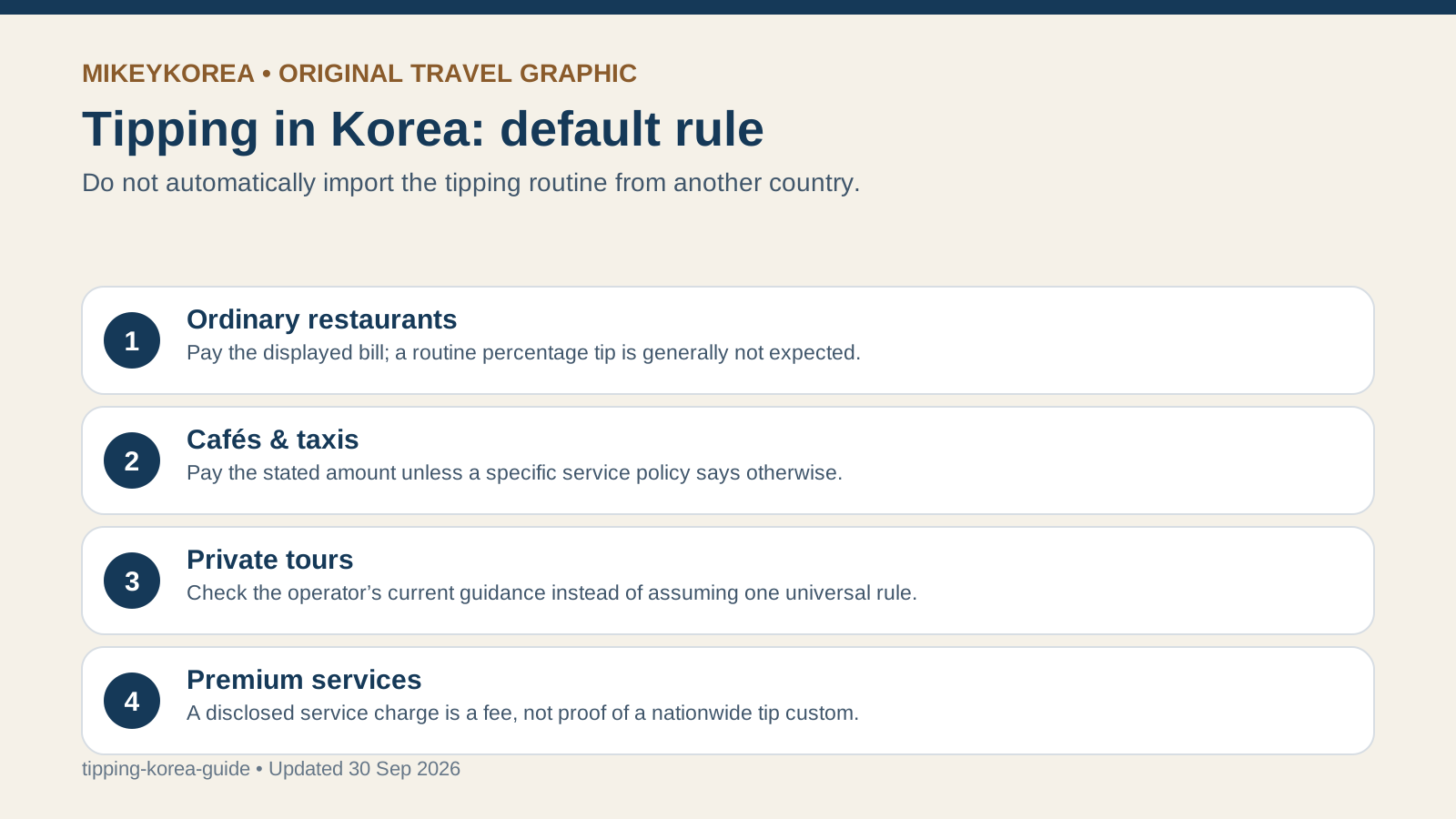
| Situation | Korea | USA | Britain | Japan |
|---|---|---|---|---|
| Sit-down restaurant | No routine percentage tip. Pay the stated bill unless a specific service policy says otherwise. | 15–20% is a common visitor guideline for a sit-down meal. | A discretionary service charge may already be on the bill; otherwise 10–15% is commonly appreciated for good service. | No routine tipping culture; pay the amount shown. |
| Taxi | Pay the metered or app fare; a percentage tip is not normally expected. | Tipping is common; official US tourism guidance suggests roughly 10–18%. | Rounding up is common; 10–15% can be a nice gesture. | No routine tip. |
| Hotel | Ordinary Korean practice does not create a universal bellhop/housekeeping tip rule. Premium international hotels may have their own service conventions. | Small staff tips are common for luggage and housekeeping. | Porters may be tipped; room-service or other tips are discretionary. | No routine tipping, though a few specialist situations have their own customs. |
| Private guide / premium service | Follow the operator’s written policy rather than importing a percentage from home. | Tipping guides and personal-service staff is common. | Discretionary and service-dependent. | Not normally expected; a private guide used to overseas guests may accept a gratuity. |
Important: this table describes mainstream visitor guidance, not every employer, booking platform or private contract. A published service charge or tour-company policy overrides the general cultural pattern.
Why Korea feels strange to travellers from strong tipping cultures
In the United States, the tip is often part of the expected economics of table service, so leaving nothing can feel morally wrong even when you know you are abroad. Korea asks you to separate appreciation from an extra percentage payment. The Korea Tourism Organization specifically tells visitors that tipping is not required or expected in Korean restaurants, and also notes that extra water or side dishes normally do not carry an additional charge.
That means an American traveller who automatically reaches for 20% is not being more respectful by doing so. You may simply be applying an American rule to a Korean transaction. A warm thank-you, a positive review, or returning to a business can communicate appreciation without creating an awkward exchange.
Why British visitors need to check the bill rather than calculate a Korean tip
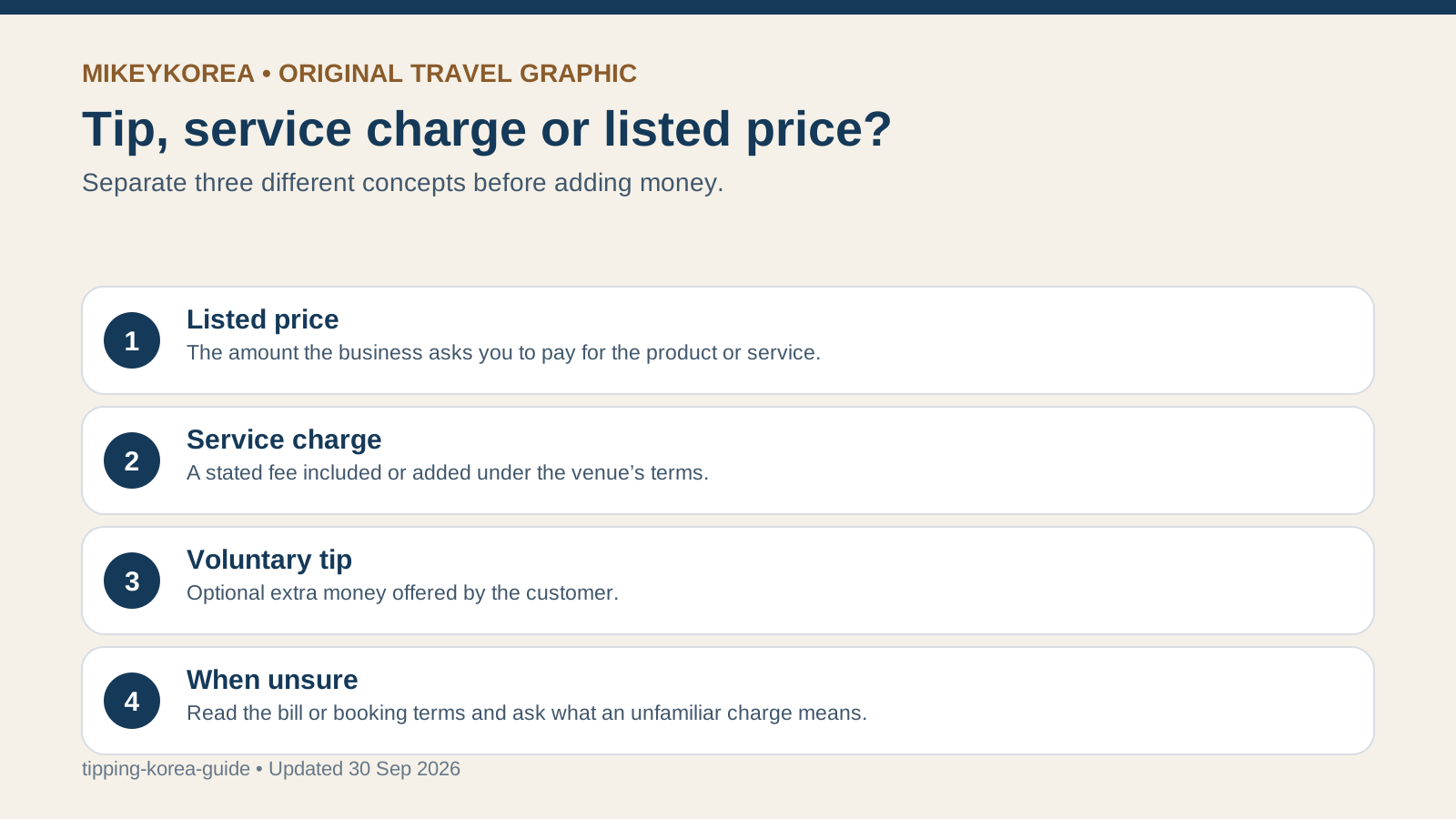
Britain sits between the US and Korean models. VisitBritain says tipping is not required in the same way as in some countries, but restaurants may add an optional service charge and a 10–15% tip can be well received when no charge is added. In Korea, the better habit is simpler: look at the amount the venue actually asks you to pay. Do not invent a second percentage merely because a British bill might have encouraged one.
Why Japanese visitors will find the basic rule familiar
Japan’s tourism authority states plainly that Japan does not have a general tipping culture. In that sense, the everyday Korean transaction will feel familiar: restaurants, taxis and most ordinary services do not require an extra gratuity. The details of manners are different, but the payment logic is much closer than it is to the United States.
What to do in the situations that cause the most uncertainty
Restaurant bill
Pay the displayed amount. If a premium venue has a separately disclosed service charge, treat that as part of the venue’s pricing rather than as proof that all Korean restaurants expect tips. If you are using a payment terminal that suddenly offers a gratuity option because it is configured for international customers, ask what the option means rather than assuming it is compulsory.
Taxi
Pay the meter or app total. You do not need to add a percentage. If a driver helps with unusually heavy luggage and you genuinely want to offer something extra, you can ask, but you should not treat a cash tip as a social obligation.
Hotel
A Korean business hotel does not automatically create the same tipping checklist that an American hotel can. At an international luxury property, however, brand standards, service charges and guest expectations may be different. Read the hotel’s own guidance.
Private guide, interpreter or bespoke tour
This is where international practices are most likely to overlap. Check the booking page first. If gratuity is mentioned, follow that policy. If not, asking the company is more reliable than copying the rule from your home country.
The MikeyKorea rule: pay the price, then check the exception
- Start with the stated price.
- Look for an explicit service charge or operator policy.
- Do not import a home-country percentage automatically.
- If you want to show extra appreciation, ask whether a gratuity is accepted.
Continue planning from here
Use the next step that matches the decision you are making now: everyday etiquette guide, dining etiquette guide, payment guide. These links are selected to continue the same travel task rather than send you back to a generic category page.
Sources and methodology
This comparison uses official visitor guidance for the country-specific tipping conventions. It is a cultural comparison, not a statement about every restaurant, hotel contract or premium service.
- VISITKOREA — About Korean Food / restaurant guidance
- Visit The USA — dining and tipping guidance
- VisitBritain — useful information / tipping
- JNTO — Tipping in Japan
Checked: 27 September 2026. Practices can differ by business, booking platform and premium service.
Use the guide, then test your own situation
Tipping is usually not the large variable in a Korea budget. Put the real daily costs into the planner and see what actually moves the total.
Related Guides
Everyday Korean Etiquette: What Feels Different from the USA, UK & Japan
Learn the Korean habits that actually matter by comparing greetings, shoes, two-handed exchanges, public transport and everyday formality with familiar visitor norms.
Paying in Korea: Cards, Cash & Wallets
A practical payment compatibility guide for visitors: where foreign Visa/Mastercard/AmEx/JCB/UnionPay usually work, where cash still matters, why transit payment is different and how to build a reliable backup.
Korea SIM vs eSIM vs Wi-Fi: Best Choice by Phone, Number & Trip Style
Choose Korea connectivity by the thing that actually matters: device compatibility, Korean 010-number needs, voice/SMS, data use, hotspot sharing, group size and trip length.