Everyday Korean Etiquette: What Feels Different from the USA, UK & Japan
Learn the Korean habits that actually matter by comparing greetings, shoes, two-handed exchanges, public transport and everyday formality with familiar visitor norms.
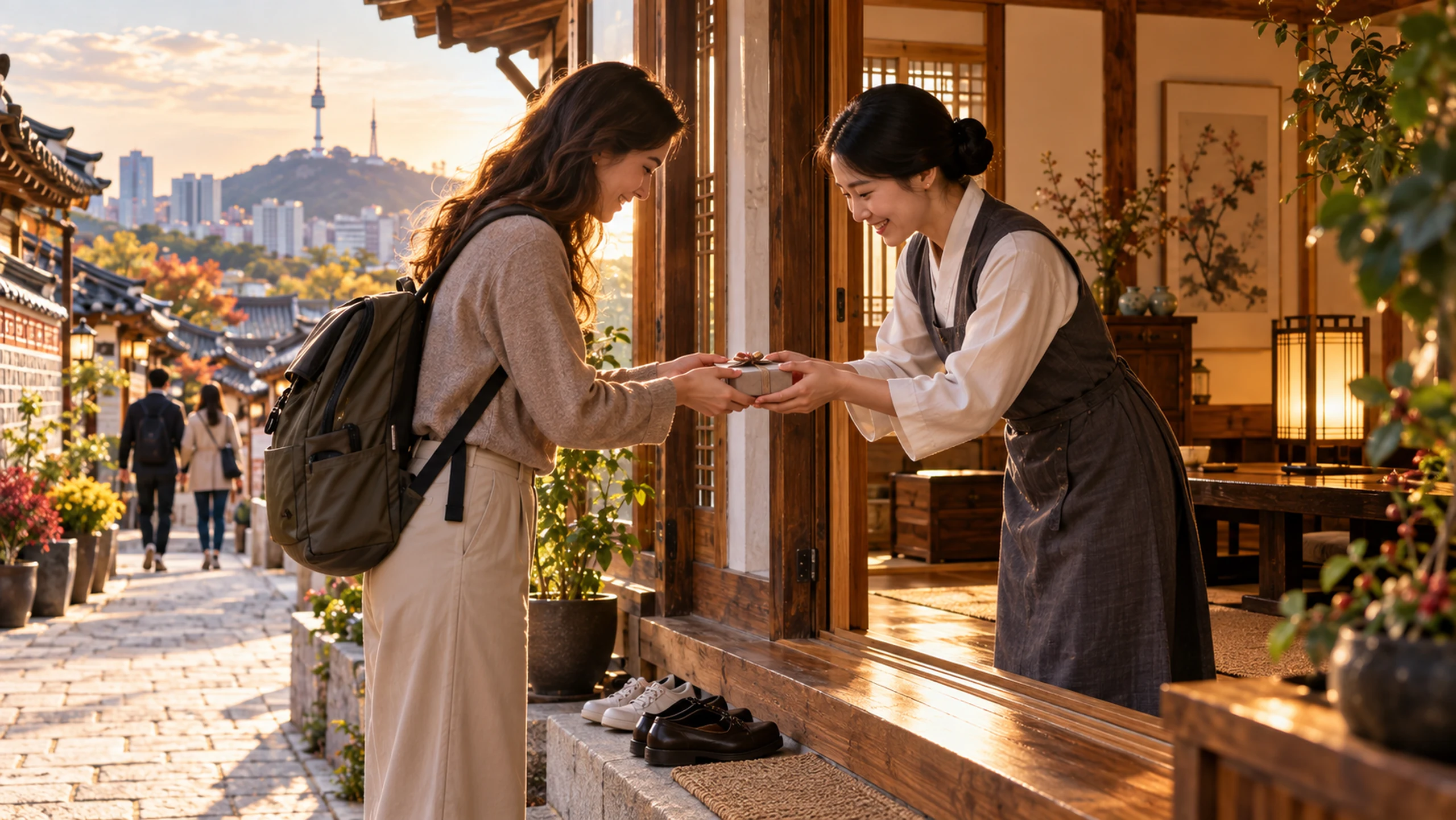
Korean etiquette becomes much easier when you stop treating it as a list of rules to memorise. The useful skill is noticing where Korea asks for a little more visible consideration or formality than you may be used to. A traveller from the United States or Britain may notice this most in greetings, age-sensitive language and the way objects are given or received. A traveller from Japan may recognise several ideas—bowing, indoor shoes, quieter public behaviour—while still finding the Korean details different.
This is a comparison guide, not a national personality test. People vary by age, setting and personality, and modern Seoul is flexible. Use the contrasts below as a way to avoid obvious friction, not as a script for “performing” Koreanness.
The everyday contrast at a glance
| Situation | Korea | USA / UK contrast | Japan contrast |
|---|---|---|---|
| Greeting | A small bow or nod is common; handshakes can accompany a greeting in business or formal settings. | Handshakes, first names and verbal greetings are generally less age-sensitive. | Bowing is also familiar, though the exact conventions and degree of formality differ. |
| Giving / receiving | Using two hands—or supporting the receiving hand with the other—is a safe respectful habit in formal or age-sensitive situations. | One-handed exchanges are usually unremarkable in everyday life. | Two-handed presentation is also familiar in formal gift and business-card contexts. |
| Shoes indoors | Remove shoes in homes, many hanok stays, temples and any venue that clearly signals it. | Household-dependent; not a universal public expectation. | Very familiar; shoe-removal zones are a well-established part of daily life. |
| Age / status | Age and role can influence speech level and how formally people address one another. | Everyday English is less structurally tied to age hierarchy. | Formality and status are also important, but expressed through Japanese social and language conventions. |
| Public transport | Let passengers off first, keep priority seating available, control large bags, and avoid creating obstruction. | The courtesy principle is familiar, but some Seoul-specific cues are more visibly standardised. | Many of the same quiet, orderly transit instincts will feel familiar. |
1. The easiest Korean habit to adopt: two hands
The official Seoul tourism guide advises visitors to give and receive objects using both hands. You do not need to turn every coffee receipt into a ceremony, but the habit is useful when receiving a gift, exchanging something with an older person, handing over a business card, or accepting a drink in a more formal social setting.
For an American or British visitor, this is a good example of a behaviour that costs almost nothing yet signals awareness. For a Japanese visitor, the basic idea of presenting an object carefully will not feel alien, even though the surrounding customs are not identical.
2. Shoes are a visual rule, not a guessing game
In a Korean home, traditional guesthouse, temple or certain floor-seating restaurants, the footwear boundary is usually obvious: a raised floor, shoe shelf, slippers or other people’s shoes tell you what to do. Follow the room rather than worrying about a universal rule. Modern shops, cafés and ordinary restaurants generally keep shoes on unless the space tells you otherwise.
The safest visitor habit is simply to look down at the entrance. If everyone’s shoes are lined up, yours probably belong there too.
3. Age matters more visibly than many English-speaking visitors expect
Korean language has formal and informal speech levels, and age or role often shapes which one people choose. You are not expected to master Korean honorific grammar on holiday. What helps is starting politely: use annyeonghaseyo rather than an overly casual greeting, and avoid assuming immediate first-name intimacy in a formal setting.
This is where many US/UK visitors feel the largest contrast. Modern British and American social life can certainly be formal, but ordinary English does not force the speaker to make age and hierarchy visible in the grammar every few sentences. In Korea, respectful tone is therefore more noticeable.
4. Public transport etiquette is practical, not ceremonial
Seoul’s official tourism guidance, updated in July 2026, emphasises four practical behaviours: leave priority seats for those who need them, control bulky backpacks, avoid spill-prone food or drink on public transport, and let passengers get off before boarding. These are less about “traditional culture” than about surviving a dense metropolitan transport system courteously.
If you are carrying a large backpack, take it off or wear it in front on a crowded train. If the doors open, make space before pushing in. These habits matter more to your daily experience than memorising ceremonial bows.
5. A small bow is enough for most travellers
A slight nod or shallow bow works naturally with annyeonghaseyo. You do not need to imitate the deep formal bows used for ceremonial occasions. The goal is to show respect, not stage a cultural performance.
What not to overthink
- You do not need to calculate everyone’s age before speaking.
- You do not need to bow deeply to shop staff.
- You will not offend everyone by using one hand for an ordinary receipt.
- You do not need to mimic drinking rituals at a casual meal among peers.
- You should not assume one Seoul household represents all Korean families.
Koreans are accustomed to international visitors. A polite traveller who observes the setting, apologises when necessary and avoids demanding special treatment will usually do better than someone anxiously acting out a checklist.
A five-second decision rule
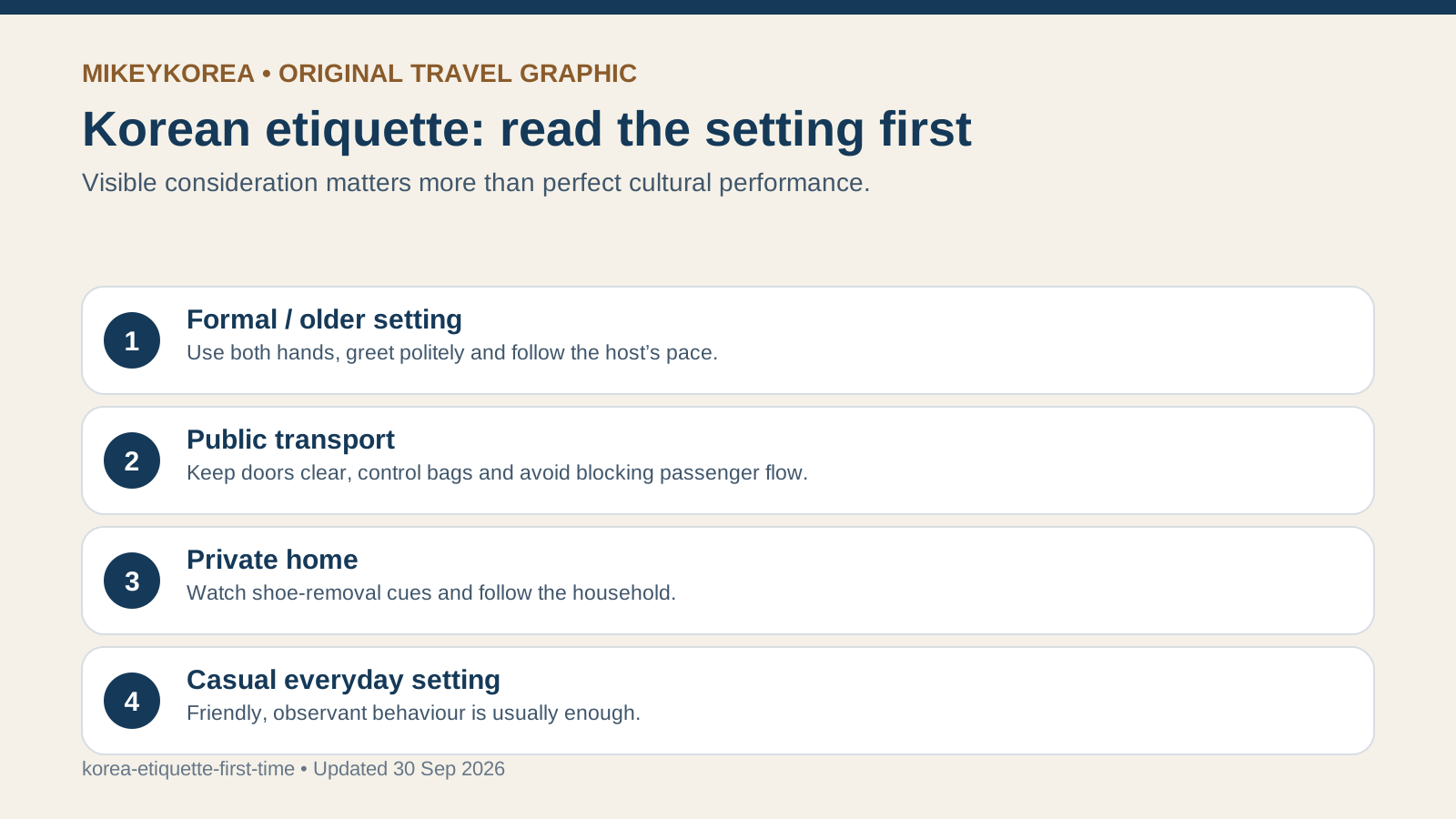
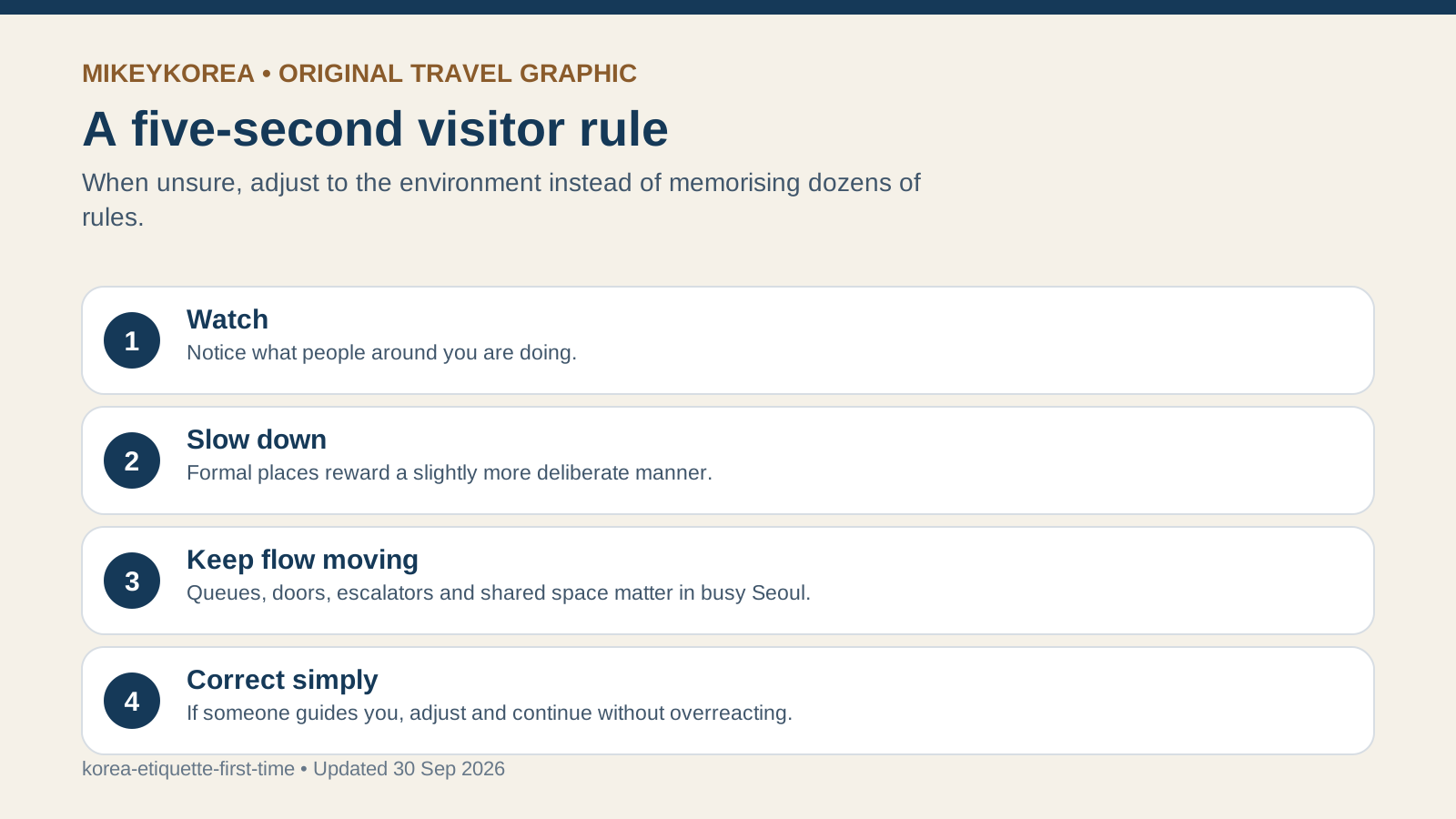
Formal, older, private-home or traditional setting? Slow down, use both hands, follow the host and start politely. Busy public everyday setting? Focus on flow: queue, keep bags controlled, avoid blocking doors and read the room.
Continue planning from here
Use the next step that matches the decision you are making now: dining etiquette guide, tipping guide, payment guide. These links are selected to continue the same travel task rather than send you back to a generic category page.
Sources and methodology
The Korea-specific behaviours are based on official Seoul visitor guidance. The US/UK/Japan columns are deliberately broad comparison cues, not rigid national rules.
Checked: 27 September 2026. Social norms vary by generation, household and setting.
Use the guide, then test your own situation
Use this guide for social context, then move to the tools hub for the practical decisions that make the first days in Korea easier.
Related Guides
Tipping in Korea vs USA, UK & Japan: What Visitors Should Do
Compare tipping in Korea with the USA, UK and Japan, then use a simple situation-by-situation guide for restaurants, taxis, hotels and tours.
Paying in Korea: Cards, Cash & Wallets
A practical payment compatibility guide for visitors: where foreign Visa/Mastercard/AmEx/JCB/UnionPay usually work, where cash still matters, why transit payment is different and how to build a reliable backup.
Korea SIM vs eSIM vs Wi-Fi: Best Choice by Phone, Number & Trip Style
Choose Korea connectivity by the thing that actually matters: device compatibility, Korean 010-number needs, voice/SMS, data use, hotspot sharing, group size and trip length.